I remember opening my first PPF account in India and seeing “7.1% interest compounded annually.” I thought, “okay, 7.1% per year, simple enough.” But then I opened a money market fund in the US that said “4.5% compounded daily,” and suddenly I had questions. Why does compounding frequency matter? Is daily compounding really better than annual?
Let me break this down with real examples.
What Is Compound Interest?
Think of compound interest as “interest on interest” - your money makes money, and then that new money also makes money.
Here’s a simple example with $100 at 10% interest per year:
$100"] --> B["Year 1
$110
(earned $10)"] B --> C["Year 2
$121
(earned $11)"] C --> D["Year 3
$133.10
(earned $12.10)"] style A fill:#5fb878 style D fill:#5fb878
Notice how you earn more each year? That’s the snowball effect.
The Formula
The compound interest formula is:
$$A = P\left(1 + \frac{r}{n}\right)^{nt}$$
Where:
- $A$ = final amount
- $P$ = principal (initial investment)
- $r$ = annual interest rate (as decimal, so 5% = 0.05)
- $n$ = number of times interest compounds per year
- $t$ = number of years
How We Get This Formula
Let’s derive it step by step. Say you start with amount $P$ and interest rate $r$ per year.
After Year 1:
- You earn interest: $P \times r$
- New amount: $P + P \times r = P(1 + r)$
After Year 2:
- You now earn interest on $P(1 + r)$
- New amount: $P(1 + r) \times (1 + r) = P(1 + r)^2$
After Year 3:
- New amount: $P(1 + r)^3$
After $t$ years:
$$A = P(1 + r)^t$$
That’s the basic formula for annual compounding!
What about compounding more frequently?
If interest compounds $n$ times per year:
- Each period gives you $\frac{r}{n}$ interest
- In $t$ years, there are $n \times t$ periods
- So we get:
$$A = P\left(1 + \frac{r}{n}\right)^{nt}$$
Compounding Frequencies Compared
Let’s invest $10,000 at 6% annual interest for 10 years and see how different compounding frequencies affect the outcome:
The Math
Annually ($n=1$):
$$A = 10{,}000\left(1 + \frac{0.06}{1}\right)^{1 \times 10} = 10{,}000(1.06)^{10} = 17{,}908.48$$
Quarterly ($n=4$):
$$A = 10{,}000\left(1 + \frac{0.06}{4}\right)^{4 \times 10} = 10{,}000(1.015)^{40} = 18{,}140.18$$
Monthly ($n=12$):
$$A = 10{,}000\left(1 + \frac{0.06}{12}\right)^{12 \times 10} = 10{,}000(1.005)^{120} = 18{,}194.25$$
Daily ($n=365$):
$$A = 10{,}000\left(1 + \frac{0.06}{365}\right)^{365 \times 10} = 10{,}000(1.000164)^{3650} = 18{,}220.51$$
Visual Comparison
$10,000
6% annual rate
10 years"] --> Annual["Annually
$17,908.48
+$7,908"] Start --> Quarterly["Quarterly
$18,140.18
+$8,140"] Start --> Monthly["Monthly
$18,194.25
+$8,194"] Start --> Daily["Daily
$18,220.51
+$8,221"] style Start fill:#5fb878 style Daily fill:#ff4088
Does Frequency Matter?
Yes, but not dramatically. Here’s the difference:
| Frequency | Final Amount | Gain vs Annual |
|---|---|---|
| Annually | $17,908.48 | - |
| Quarterly | $18,140.18 | +$231.70 |
| Monthly | $18,194.25 | +$285.77 |
| Daily | $18,220.51 | +$312.03 |
Daily compounding gives you $312 more than annual compounding over 10 years. Not huge, but free money is free money.
The rule: More frequent compounding is always better, but the difference gets smaller as you compound more often. Going from annual to monthly matters more than going from monthly to daily.
Real-World Examples
Example 1: Fidelity Money Market Fund (USA)
You invest $10,000 in a money market fund with 4.5% annual yield, compounded daily.
How it works:
- Dividends paid daily
- Automatically reinvested (buy more shares)
- This is n = 365
After 1 year:
$$A = 10{,}000\left(1 + \frac{0.045}{365}\right)^{365 \times 1} = 10{,}000(1.000123)^{365} \approx 10{,}460$$
You earned $460 instead of just $450 (simple interest) thanks to daily compounding.
After 10 years:
$$A = 10{,}000(1.000123)^{3650} \approx 15{,}657$$
Example 2: PPF - Public Provident Fund (India)
You invest ₹1,50,000 per year (maximum allowed) for 15 years at 7.1% annual interest, compounded annually.
How it works:
- Interest compounds once per year
- Calculated on lowest balance between 5th and end of month
- This is n = 1
Strategy: Invest on April 1st each year to maximize interest.
Calculation:
Invest: ₹1,50,000
Balance: ₹1,60,650"] --> Y2["Year 2
Invest: ₹1,50,000
Balance: ₹3,32,556"] Y2 --> Y3["Year 3
Invest: ₹1,50,000
Balance: ₹5,14,045"] Y3 --> Y15["...
Year 15
Invest: ₹1,50,000
Balance: ₹40,68,209"] style Y1 fill:#5fb878 style Y15 fill:#ff4088
Final result after 15 years:
- Total invested: ₹22,50,000
- Final amount: ₹40,68,209
- Interest earned: ₹18,18,209
Your money almost doubled! And it’s completely tax-free (EEE status).
Comparison: Money Market vs PPF
| Feature | Fidelity Money Market | Indian PPF |
|---|---|---|
| Compounding | Daily (365×/year) | Annually (1×/year) |
| Rate | ~4.5% | 7.1% |
| Liquidity | Withdraw anytime | Locked 15 years |
| Taxation | Taxable income | Tax-free (EEE) |
| Best for | Emergency fund, liquidity | Long-term, tax savings |
The Power of Time
Here’s the real magic of compound interest - time matters more than frequency.
Let’s compare two scenarios with $10,000 at 6%:
Scenario A: Daily compounding, 10 years = $18,220.51 Scenario B: Annual compounding, 20 years = $32,071.35
daily compounding
$18,220"] B["20 years
annual compounding
$32,071"] A -.->|"10 more years"| C["20 years
daily compounding
$33,201"] style B fill:#5fb878 style C fill:#ff4088
Key insight: An extra 10 years beats better compounding frequency. Time is your most powerful tool.
Where Can You Get Compound Interest?
United States
Daily Compounding:
- Money market funds (Fidelity, Vanguard, Schwab)
- High-yield savings accounts (Marcus, Ally Bank)
- CDs (Certificates of Deposit)
Monthly/Quarterly:
- Most bonds (if you reinvest interest)
- Dividend-paying stocks (DRIP programs)
Through Reinvestment:
- 401(k) - All gains compound tax-deferred
- IRA (Traditional and Roth)
- Index funds / ETFs with dividend reinvestment
India
Annual Compounding:
- PPF (Public Provident Fund) - 7.1%, tax-free
- EPF (Employee Provident Fund) - 8.15%
- Sukanya Samriddhi Yojana - 8.2%
Quarterly Compounding:
- Fixed Deposits (banks)
- Recurring Deposits
- National Savings Certificate (NSC)
Through Market Growth:
- Mutual funds with dividend reinvestment
- SIP (Systematic Investment Plan)
- NPS (National Pension System)
Practical Examples: How Your Money Grows
Let’s look at real numbers. Here’s what happens when you invest $10,000 at different rates over various time periods (assumes annual compounding for simplicity):
Conservative Rate (5% - High-Yield Savings, CDs)
| Years | Amount | Total Gain |
|---|---|---|
| 1 | $10,500 | $500 |
| 3 | $11,576 | $1,576 |
| 5 | $12,763 | $2,763 |
| 10 | $16,289 | $6,289 |
| 20 | $26,533 | $16,533 |
| 30 | $43,219 | $33,219 |
Takeaway: Even at 5%, your money more than doubles in 15 years and quadruples in 30.
Moderate Rate (8% - Typical Stock Market Long-Term Average)
| Years | Amount | Total Gain |
|---|---|---|
| 1 | $10,800 | $800 |
| 3 | $12,597 | $2,597 |
| 5 | $14,693 | $4,693 |
| 10 | $21,589 | $11,589 |
| 20 | $46,610 | $36,610 |
| 30 | $100,627 | $90,627 |
Takeaway: At 8%, your money doubles roughly every 9 years. After 30 years, that $10,000 becomes over $100,000.
Aggressive Rate (10% - High-Growth Stocks, Index Funds)
| Years | Amount | Total Gain |
|---|---|---|
| 1 | $11,000 | $1,000 |
| 3 | $13,310 | $3,310 |
| 5 | $16,105 | $6,105 |
| 10 | $25,937 | $15,937 |
| 20 | $67,275 | $57,275 |
| 30 | $174,494 | $164,494 |
Takeaway: At 10%, money doubles approximately every 7 years. After 30 years, $10,000 grows to over $174,000.
Monthly Contribution Example
What if instead of a one-time $10,000, you invest $500/month ($6,000/year) at 8% annual return?
| Years | Amount | Your Contributions | Earnings |
|---|---|---|---|
| 1 | $6,244 | $6,000 | $244 |
| 3 | $19,780 | $18,000 | $1,780 |
| 5 | $36,738 | $30,000 | $6,738 |
| 10 | $91,473 | $60,000 | $31,473 |
| 20 | $294,510 | $120,000 | $174,510 |
| 30 | $745,180 | $180,000 | $565,180 |
Takeaway: Regular contributions combined with compound interest is incredibly powerful. After 30 years, you’d have contributed $180,000 but end up with $745,000 - more than 4x your contributions!
The Rule of 72
Quick mental math: To estimate how long it takes to double your money, divide 72 by the interest rate:
- At 6%: 72 ÷ 6 = 12 years to double
- At 8%: 72 ÷ 8 = 9 years to double
- At 10%: 72 ÷ 10 = 7.2 years to double
This is why time and rate both matter so much.
The Bottom Line
Three key takeaways:
- Compound interest is powerful - Your money makes money, which makes more money
- Frequency helps, but not dramatically - Daily vs annual might add 1-2% over time
- Time matters most - 20 years of annual compounding beats 10 years of daily compounding
What to do:
- Start early (even small amounts)
- Reinvest your earnings (dividends, interest)
- Be patient - compounding needs time to work its magic
- Don’t obsess over compounding frequency - focus on getting started
Remember: 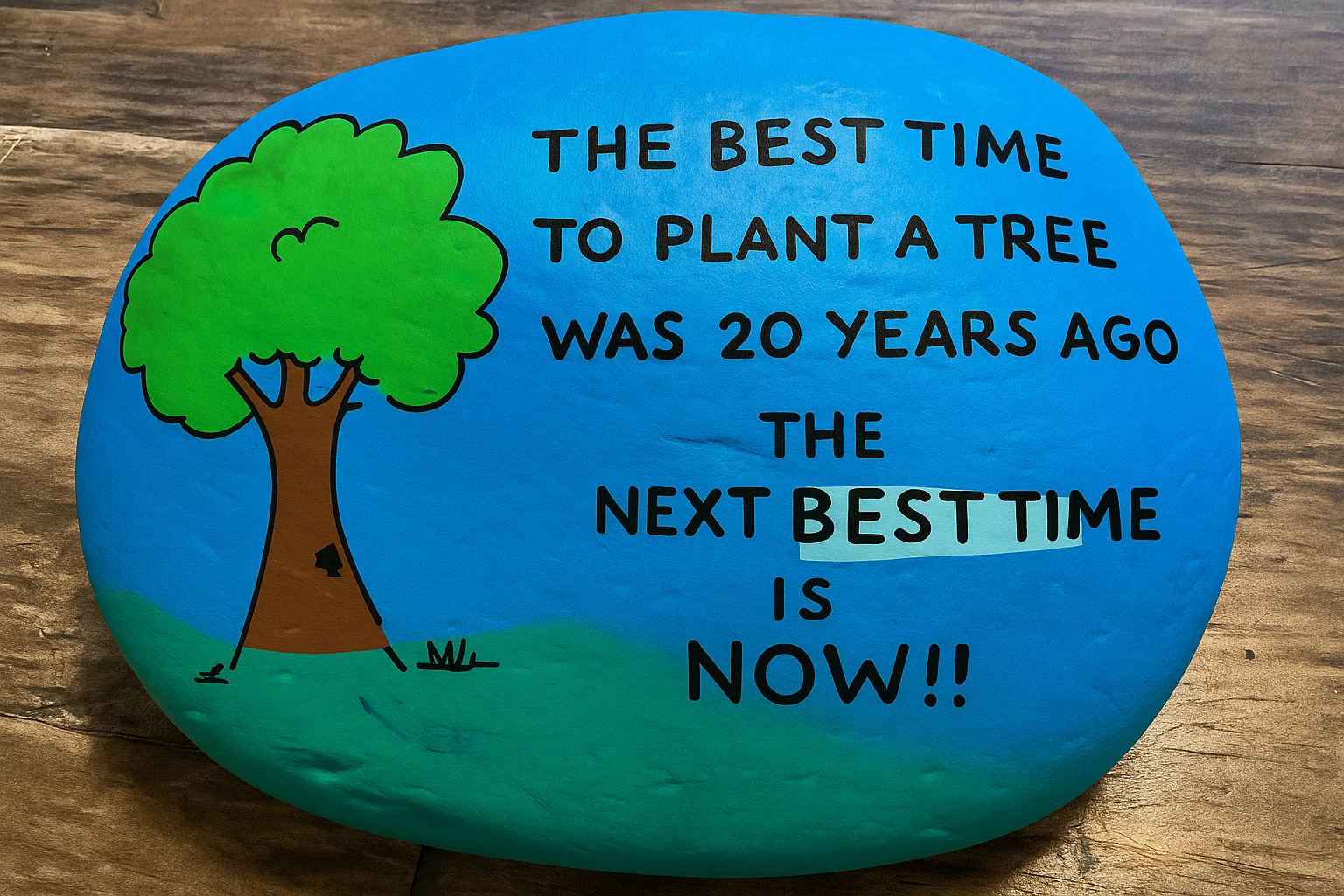
Thanks to Preeti Agarwal for painting this rock for me. This image has been digitally enhanced.